


Success Story
McElhanney
How McElhanney turned years of CAD, Geomatics, and digital expertise into a scalable learning and standards engine for 1,500 employees.

“We had years of knowledge… and no way to share it.”
For over 116 years, McElhanney has built its reputation on technical excellence across geomatics, engineering, transportation, construction, BIM, GIS, and emerging digital technologies.
- With growth to 1,500 people across 32 offices, the focus shifted toward maintaining consistency and making valuable knowledge easily accessible across teams. Different offices developed different standards.
- CAD support team answered the same questions over and over.
- And when COVID removed in-person learning, the cracks became impossible to ignore.
This wasn’t a training problem, it was about scale, consistency, and knowledge-sharing.
What the Challenges Looked Like Day to Day
As McElhanney expanded its workforce, opportunities emerged to better align standards across teams.
Onboarding varied between offices. Rework was happening, not because teams lacked skill, but because they had learned different ways of doing the same work. Super users and experienced CAD staff found themselves repeating the same workflows and answering the same technical questions repeatedly.
In some cases, the same CAD question was being asked dozens of times across the company simply because there was no central place for that knowledge to live.
At the same time, employees were at very different stages in their digital journey. Some needed foundational support. Others were ready for advanced workflows, AI exploration, and deeper digital standards. The team needed a way to understand who needed what and guide learning intentionally.
Learning demand also came in waves, new software releases, onboarding periods, AI initiatives. This created spikes the team was constantly trying to stay ahead of.
And perhaps most importantly, it highlighted the need for a more consistent and scalable way to share knowledge.
Employees were relying on colleagues for training, and the organization needed a scalable, accessible content library to support the growing needs of staff.
They needed a way to organize, scale, and guide how knowledge was accessed.
Inside McElhanney’s Digital Innovation Team
When we sat down with McElhanney’s digital leaders, it was clear this initiative wasn’t coming solely from an HR or IT directive. McElhanney leadership saw the need for a new training initiative and looked to the CAD Standards Committee and the newly formed ML Digital team to come up with a solution.
We spoke with:
- Brey Tucker — Digital Leader
- Kristen MacKay —Digital Program Manager
- Vicki Sjoberg — CAD Lead, Digital Technology Leadership Team
- Chris Waight — BIM Lead, Digital Technology Leadership Team Lead
Together, they represent a subset of McElhanney’s digital team (ML.Digital) — a 50-person group supporting standards, innovation, workflows, and technology adoption for 1,500 employees.
Their mandate spans CAD, BIM, GIS, Geospatial Technology, Visualization, and even the rise of AI, with Microsoft Copilot enablement.
As Brey described it, their role is to “serve the entire organization’s technology needs while preparing the company for what’s next.”
But for decades, McElhanney’s technical software training was mandated to a group of experienced individuals in our CAD Standards Committee, who worked on standards “off the side of their desk” and developed CAD content, refined workflows, and contributed to standards built from from project experience. Vicki and her counterpart, Trevor Deleske, have developed over 1,000 worth of custom CAD processes for Geomatics workflows alone.
The expertise existed. It just wasn’t scalable, without physically taking resources away from their daily work.

Learning Had to Become Infrastructure
When this team came together, something became clear.
If digital standards, BIM, AI, and evolving workflows were going to shape McElhanney’s future, then learning couldn’t be something people did when they had time.
It had to be built into how the company operates.
This also wasn’t a brand-new idea. McElhanney had been working with SolidCAD for years, and conversations around skills, standards, and scalable learning had come up more than once. At the time, it was something to keep in mind.
But now, it had become urgent.
SolidCAD wasn’t just another software provider in this decision. They were a familiar partner who already understood McElhanney’s environment, their tools, and the challenges they were trying to solve. That history made it easier to move from discussion to action.
Together, they implemented:
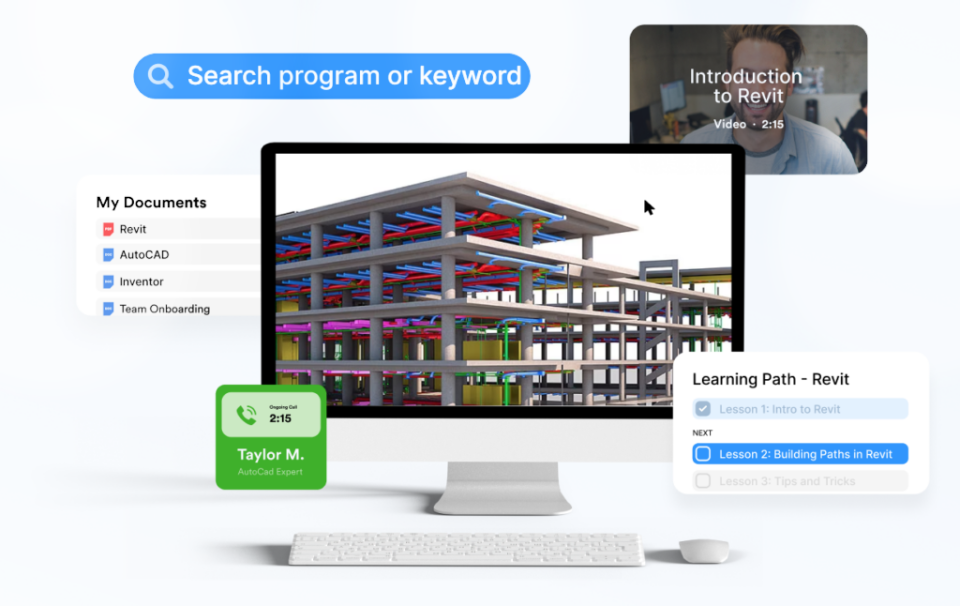
- Pinnacle Series — a centralized place to access learning and internal knowledge
- KnowledgeSmart — a way to understand where skills existed and where support was needed
This became an initiative in building a knowledge engine that could support the entire organization.
From “Who do I ask?” to “Check Pinnacle.”
Even shortly after rollout, a shift began to appear.
Instead of asking, “Who can help me?” employees began asking, “Is this on Pinnacle?”
Pinnacle provided McElhanney with a centralized place to access a deep library of AECO-focused CAD, BIM, and digital workflow content, alongside the ability to begin housing their own internal standards, workflows, and knowledge in the same environment.
At the same time, KnowledgeSmart introduced something they hadn’t had before: visibility into skills.
For the first time, the team could start to plan for assessing:
- Where employees were in their digital skill journey
- What content would support them at their stage
- How learning paths could guide development instead of relying on ad-hoc support
The CAD support team began seeing fewer repetitive questions. New hires have a clearer starting point for learning. Leaders have begun exploring how learning paths could support coaching conversations. Employees have started looking for answers inside Pinnacle before looking for a person.
What used to require a conversation was beginning to take a click.

Adoption That Told a Story
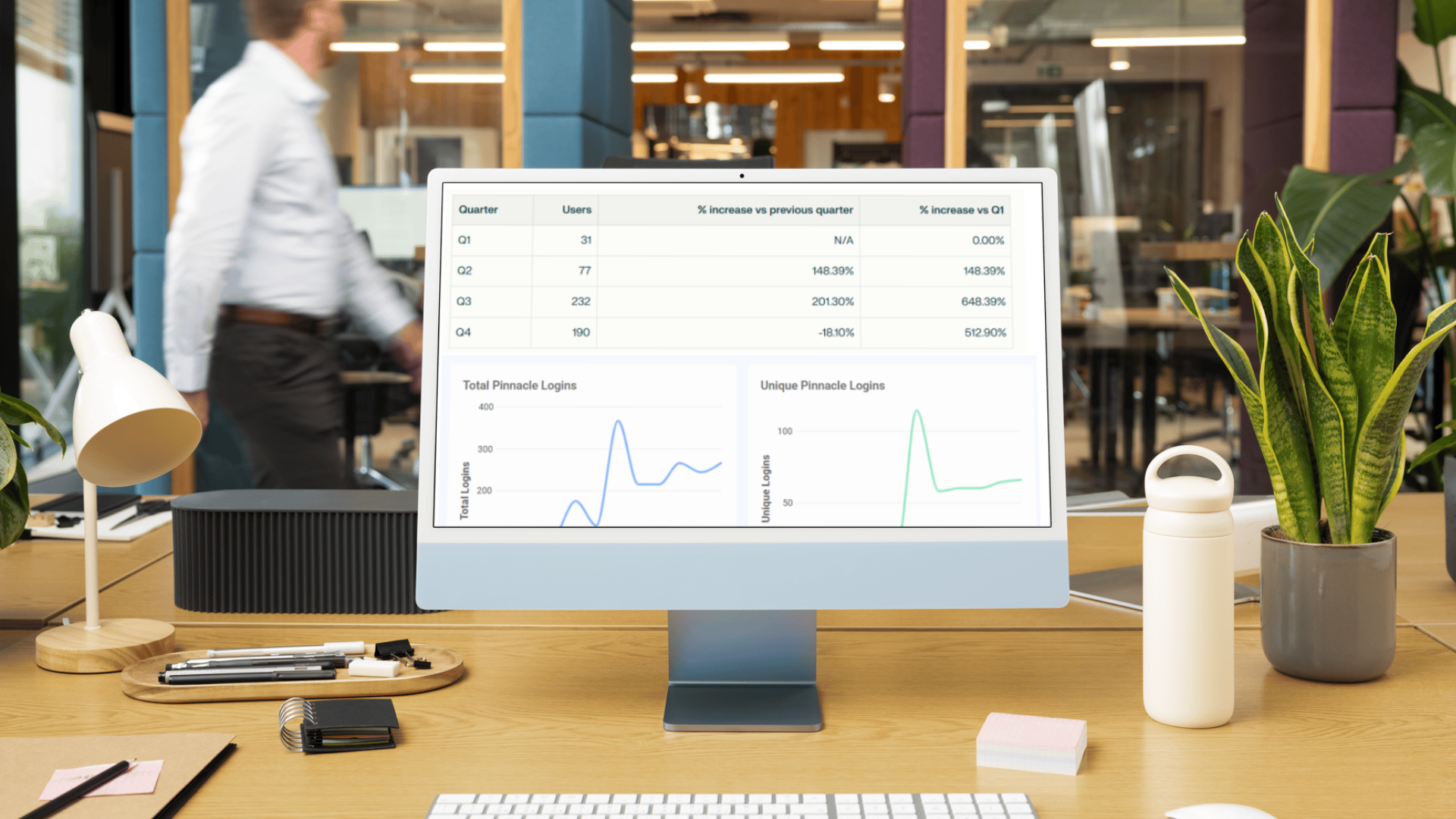
| Quarter | Unique Users |
| Q1 | 31 |
| Q2 | 77 |
| Q3 | 232 |
| Q4 | 190 |
That’s 648% growth from Q1 to Q3.
Nearly 200 users every month and 167 courses actively used across content for CAD, BIM, digital standards, and AI.
The spike wasn’t mandated. It happened because employees wanted to learn.
Building Subject Matter Experts — Intentionally
One of the most insightful points Brey shared was how developing subject matter experts inside McElhanney goes far beyond improving day-to-day project work. It plays a direct role in shaping the future services the company can offer.
When employees build deeper expertise in CAD, BIM, digital workflows, data, and emerging technologies, they aren’t just working more efficiently. They begin to recognize new possibilities, contribute new ideas, and identify new ways McElhanney can support its clients.
This is where KnowledgeSmart and Pinnacle work together in a powerful way.
KnowledgeSmart provides visibility into where skills already exist across the organization and where additional support is needed. Pinnacle then offers structured learning paths that help employees intentionally build those skills over time.
Rather than relying on experience to develop organically, McElhanney now has a way to grow expertise across the firm with purpose.
For McElhanney, building subject matter experts became more than improving internal efficiency and more about expanding what the organization is capable of delivering in the future.


A Living Knowledge System — And the Start of a Cultural Shift
Pinnacle is now the go-to hub for technical services, CAD, BIM, and digital standards at McElhanney.
Teams continue to leverage the extensive content already available in Pinnacle, while also uploading and refining custom content. Internal workflows are being documented. Assessment data can be used for coaching. Leaders can now connect training to project performance.
Employees feel more confident contributing their own knowledge. And this is only the beginning.
As McElhanney looks toward more AI adoption, evolving software, and future standards, Pinnacle will remain the central place where knowledge is built, stored, and shared.
SolidCAD will continue to support McElhanney in expanding this internal content — ensuring their expertise scales as the company grows.
Building the Future of Expertise
What began as a response to overwhelmed support teams has become the foundation for how 1,500 people learn, work, and evolve digitally.
McElhanney didn’t solve a training problem.
They solved how knowledge lives inside an organization.
Testimonial
“What really stood out for us wasn’t just the idea of training — it was the ability to turn the knowledge we’ve built over decades into something everyone at McElhanney can access. Pinnacle and KnowledgeSmart are helping us grow subject matter experts across the organization, and that directly impacts the kinds of services and value we can bring to our clients. It’s not about learning for the sake of learning. It’s about building the capability of our people in a way that scales with the company.”
— Brey Tucker, Digital Leader, McElhanney
Similar Projects

Énergir
Procepack